The Christian Association of Nigeria (CAN) is the premier ecumenical body representing millions of Christians across various denominations in Nigeria. Established in the late 1970s, CAN serves as the central voice for the Christian faith, promoting inter-denominational unity, defending religious freedom, and engaging the government on social, political, and moral welfare issues.
1. Background and Historical Foundation (1976)
The formation of CAN was catalyzed by a specific event in August 1976.
The Dodan Barracks Meeting: On August 27, 1976, the Federal Military Government led by General Olusegun Obasanjo invited various Christian leaders to Dodan Barracks in Lagos. The government aimed to consult church leaders regarding the introduction of the National Pledge and National Flag Recitation into primary and secondary school curricula.
The Post-Meeting Gathering: The Christian leaders agreed to the proposal on the condition that morning devotions and prayer would precede these recitations. Realizing that Christians lacked a unified, singular umbrella organization to address issues affecting the faith, the leaders adjourned from Dodan Barracks to the nearby Catholic Secretariat in Lagos.
Establishment: At this caucus, the leaders formally resolved to form a unified organization. Out of several proposed names, they chose the Christian Association of Nigeria (CAN).
First Constitution: The association’s first constitution was formally signed on April 20, 1977.
2. Foundational Leadership
The founding fathers comprised key figures from mainline Protestant bodies and the Catholic Church:
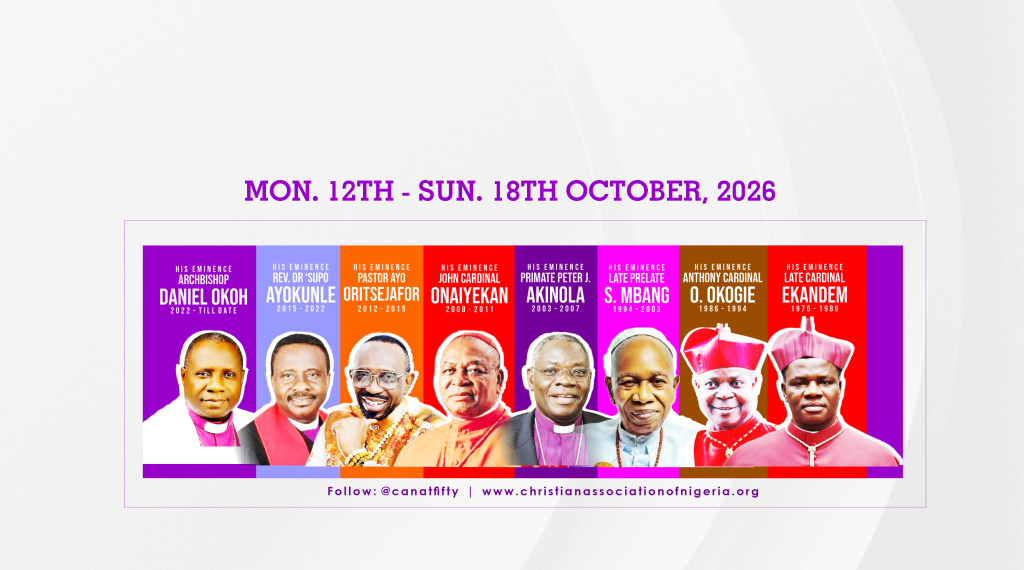
First President: His Eminence, Cardinal Dominic Ekandem (Catholic Church)
First General Secretary: Rev. Dr. Joseph A. Adegbite (Christian Council of Nigeria)
Key Co-Founders: Archbishop Francis Arinze, Cardinal Anthony Okogie, and Rt. Rev. Festus O. Segun, among others.
3. Structural Composition (The 5 Blocs)
To maintain equity and represent the diversity of Nigerian Christianity, CAN is structured into five main church groups or blocs:
1. Catholic Secretariat of Nigeria (CSN): Represents the Roman Catholic Church in Nigeria.
2. Christian Council of Nigeria (CCN): Includes mainline Protestant denominations such as the Anglican, Methodist, Baptist, Presbyterian churches, etc.
3. Pentecostal Fellowship of Nigeria (PFN) / CPFN: Comprises Pentecostal, charismatic, and evangelical churches.
4. Organisation of African Instituted Churches (OAIC): Represents indigenous African churches (e.g., Aladura, Celestial Church of Christ, Cherubim and Seraphim).
5. ECWA / TEKAN Fellowship: Represents the Evangelical Church Winning All (ECWA) and Tarayar Ekklesiyoyor Kristi A Nijeria (TEKAN), predominantly based in Northern Nigeria.
CAN also operates specialized organs, including the Women Wing of CAN (WOWICAN) and the Youth Wing of CAN (YOWICAN), along with state and geopolitical zonal chapters across Nigeria.
4. Major Historical Roles and Evolution
A. Advocacy for Religious Rights and Secularism
Throughout the 1980s and 1990s—particularly under the presidency of Cardinal Anthony Okogie (1988–1995) —CAN emerged as a vocal critic of military rule and policies perceived to undermine Nigeria’s secular charter. CAN strongly opposed Nigeria’s full enrollment into the Organisation of Islamic Cooperation (OIC) in 1986, arguing that state resources and national alignment should remain non-sectarian.
B. Response to Sharia and Northern Ethno-Religious Conflicts
In 1999–2000, as some northern states instituted full Sharia criminal law, CAN served as the key advocacy body protesting potential rollbacks of constitutional rights for non-Muslim minorities. During periods of sectarian violence in the Middle Belt and North, CAN mobilized relief programs and served as an interlocutor with local and federal authorities.
C. Interfaith Relations
CAN regularly engages in dialogue with the Nigerian Inter-Religious Council (NIREC) alongside the Nigerian Supreme Council for Islamic Affairs (NSCIA) to promote peaceful coexistence, manage crises, and foster interfaith tolerance.
Vision Statement

To be the unifying voice of all Christians in Nigeria, amplifying their views, interests and enhancing the spiritual development of all followers of Christ.
Mission Statement

To connect people to Jesus and one another by helping them to grow their faith, finding the true essence of Christianity and build healthy Christian relationships.
To foster ecumenism by uniting all denominations in the body of Christ so as to promote understanding, peace, unity and mutual respect.
To build a great nation for all people through gospel movement, community formation, social justice and cultural renewal.
CAN OBJECTIVES
To serve as a basis of response to the unity of the Church, especially as contained in our Lord’s
pastoral prayer: ‘’That they all may be one’’. ( John 17 : 21)
To promote understanding, peace and unity among the various people and strata of society in
Nigeria, through the propagation of the Gospel.
To act as a liaison committee, by means of which its member-churches can consult together and
when necessary, make common statement and take common actions.
To act as watch-man of the spiritual and moral welfare of the nation.
CAN CONSTITUTION

Feel free to download the CAN Constitution